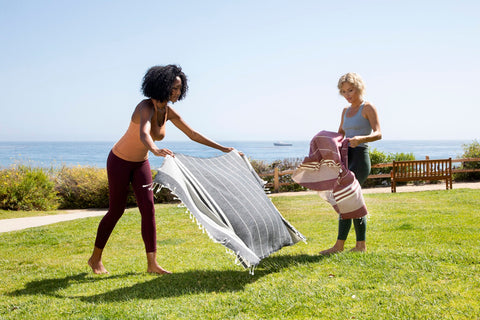
What Is a Turkish Towel (Peshtemal)? The Complete Guide

A Turkish towel is a lightweight, flat-woven towel, traditionally made from cotton, with no thick loops of terry pile. In Turkey it is called a peshtemal (you will also see pestemal or fouta in some markets). It absorbs well, dries quickly, folds down small and gets softer every time it is washed. That combination is why a cloth born in the bathhouse now lives in beach bags, hotel spas and branded gift boxes around the world.
If you source promotional products, or you are simply curious about why this humble rectangle has such a devoted following, this guide walks through what a peshtemal is, how it is made, how to judge quality and where it earns its place.
What exactly is a peshtemal?
The word describes a flat-woven cloth, usually rectangular, finished with fringe or tassels at both short ends. "Flat-woven" is the important part. A standard bath towel is made with a pile of looped yarn standing up from a base fabric, and those loops are what hold water and give a towel its plush feel. A peshtemal has no loops. It is a single, tightly constructed layer of fabric, and its absorbency comes from the cotton fibre and the open, breathable weave rather than from bulk.
The result is a cloth that feels crisp and cool in the hand when new and turns soft and supple with use. Because it is thin, it behaves differently from terry in nearly every way: it drapes, wraps, knots and folds, and it does not hold on to moisture the way a thick towel does.

Where does the Turkish towel come from?
The peshtemal belongs to the hammam, the Turkish bath, a social and ritual institution that flourished across the Ottoman world. Bathers wrapped themselves in a flat cloth for modesty and warmth, dried off with it and relaxed in it afterwards. Light cloth suited a steamy room far better than a heavy one, and it could be washed and dried quickly between visitors.
Over generations the cloth became part of everyday Turkish life: used at the sea, at home, in the kitchen and as a wrap. Weaving communities developed their own patterns, stripes and checks, and regions of western Turkey, including the area around Denizli, grew into major textile centres. If you want the full story, we cover the culture and its evolution in our history of the Turkish bath towel.
How is a Turkish towel made?
The traditional method uses a loom to interlace warp threads (running lengthwise) and weft threads (running across) in a simple pattern, with the fabric built up row by row. Stripes and checks come from changing the colour of the yarns, and more elaborate designs come from looms with jacquard mechanisms that lift individual threads to form a pattern directly in the cloth.
Once woven, the towel is cut to length and the ends are finished with fringe. On quality pieces the fringe is twisted or knotted so it does not unravel in the wash. Then comes finishing: washing, softening and pressing, so the cloth arrives with a pleasant hand feel and lies flat.
Our flat-woven towels are produced with small, family-run mills in Turkey, which is where this craft has deep roots. We go into the process, step by step, in From Loom to Logo.
What makes a good one? Fibre, weave and finish
Two towels can look nearly identical on a screen and feel nothing alike in your hands. Three things explain the difference.
The cotton
Fibre length matters. Long-staple cotton produces smoother, stronger yarn with fewer loose ends, which means a cloth that feels better, pills less and lasts longer. Our towels use long-staple cotton grown in the Aegean region of Turkey, a part of the world long associated with fine cotton. For more on why origin changes the feel, see Turkish Cotton Explained.
The weave
A tighter, more even weave gives a cleaner surface, sharper pattern definition and a towel that holds its shape. A loose, uneven weave can look rustic if that is intended, but it can also mean thin spots and distortion after washing. Look at the cloth against a window: you want consistent texture, straight lines and no obvious gaps.
The finishing
Fringe, edges and pressing are where careful makers show their hand. Check that the fringe is neat and secure, that the selvedges run straight and that the cloth has been washed and softened rather than left stiff. Each of our pieces is inspected, pressed, folded and packed before it ships.
A peshtemal is a towel that gets better with age, which is a rare thing to say about a promotional product.
How does a Turkish towel compare with a regular towel?
The two are good at different things, and neither is "better" in every situation. Here is a quick comparison of how they typically behave. For the full breakdown, including what it means for a brand, read Peshtemal vs Terry Towel.
| Feature | Turkish towel (peshtemal) | Terry towel |
|---|---|---|
| Construction | Flat weave, no loops | Looped pile |
| Weight and bulk | Light, folds small | Heavier, bulky |
| Drying time | Quick | Slower |
| Feel | Crisp when new, softer with every wash | Plush from day one |
| Sand and lint | Sheds sand easily, low lint | Sand can cling to loops |
| Versatility | Towel, wrap, throw, scarf, picnic cloth | Mostly a towel |
| Logo decoration | Flat surface suits woven, embroidered and printed art | Pile can soften fine detail |
Where are Turkish towels used?
The flat weave opens up uses that a thick towel cannot match.
- Beach and pool. They pack small, dry fast and shake clean of sand. That makes them the obvious choice for a beach bag.
- Spas and hammams. Their traditional home. A light wrap is comfortable in warm, humid rooms.
- Hotels and resorts. Stylish, easy to launder and quick to turn around, they suit poolside service and guest amenities.
- Travel and gyms. A towel that takes little room in a bag is a real advantage.
- Home. Kitchen cloth, sofa throw, tablecloth, light blanket or scarf.
- Gifting. Rolled, tied and presented well, a peshtemal looks like a considered gift, not a freebie.
Why do brands and distributors choose Turkish towels?
For promotional-product distributors, a peshtemal solves a familiar problem: finding an item that recipients keep, use and show off. A few reasons it works.
- Useful, so it stays in circulation. A towel that lives in a beach bag keeps a logo visible all summer.
- A generous canvas. The flat, wide surface gives artwork room to breathe.
- Several ways to decorate. Jacquard weaving turns a logo into part of the fabric, embroidery adds texture, and printing delivers vibrant, colourful artwork.
- Compact to store and ship. Lighter and flatter than terry, which is kind to warehouse space and packaging.
- A story to tell. Craft heritage and natural fibre give an end client something more interesting to say than "here is a towel."

How can you customise a Turkish towel?
Customisation is where a good towel becomes your client's towel. The main options are:
- Jacquard weaving. The logo is woven directly into the fabric, so it cannot peel or crack. Ideal for a premium, lasting result.
- Embroidery. Stitched artwork adds texture and a tactile, upscale feel, well suited to monograms and simple marks.
- Printing. The best route for vibrant, multi-colour designs and artwork with fine gradients.
- Colour. Yarn colours are matched to a Pantone equivalent, and our yarn swatch page shows 45 colours to choose from.
- Finishing touches. Custom hang tags, woven labels, branded belly bands or sleeves and personalised packaging turn the towel into a finished product.
Not sure how a design will look on cloth? Request virtuals before committing, and samples when you want to feel the weight and hand of the towel yourself. Both save awkward conversations with end clients later.
How do you care for a Turkish towel?
Wash it in warm water with a mild detergent and skip fabric softener, which can coat the fibres and reduce absorbency. Tumble dry on low or hang to dry, which takes very little time. Expect the first few washes to soften the cloth noticeably. A little fringe tidying now and then is the only maintenance it asks for. We will give this its own full treatment in a dedicated care guide.
Can you order custom Turkish towels in volume?
Yes. Some inventory is ready to ship from California, and additional inventory in Turkey ships in 7-10 days. Made-to-order production takes about two weeks in Turkey. Wholesale pricing is available to logged-in distributors, and quantity price breaks are pooled, so mixing colours or styles earns the break of the lower-priced style. You can browse current inventory or the full collection to see what is possible.
Our work also has a purpose beyond the towel. Our mission is to help heal and protect the oceans, which feels right for a product made to be used beside the sea.
Frequently asked questions
What is the difference between a Turkish towel and a peshtemal?
Nothing. Peshtemal is the Turkish word for a flat-woven towel, and Turkish towel is the English name most people use. You may also see it spelled pestemal.
Are Turkish towels absorbent?
Yes. Cotton is naturally absorbent, and the flat weave lets water move through the cloth and evaporate quickly. A Turkish towel will not feel as thick as terry, but it dries you well and then dries itself far faster.
Do Turkish towels get softer over time?
They do. A new peshtemal is usually crisp and slightly firm, and each wash relaxes the fibres. Many owners say their oldest towel is their favourite.
Can a logo be added to a Turkish towel?
Yes. A logo can be woven in with jacquard, embroidered or printed, and finished with custom hang tags, woven labels, belly bands or personalised packaging.
What is a Turkish towel best used for?
It excels wherever light weight and fast drying matter: the beach, the pool, the spa, the gym and travel. It also works at home as a throw, wrap or kitchen cloth.
See a peshtemal in your brand colours
Browse what is ready to ship, request samples to feel the cloth, or ask for virtuals to see your logo before you commit.
View inventory Contact our team