Made in Turkey Towels: Why We Make Textiles in Turkey

We make custom textiles in Turkey because that is where the best flat-woven towels have always come from, and because the mills there combine inherited skill with modern looms. It is a choice about craft and materials, not a marketing line. This is the story of why we made it, what it looks like on the ground, and what it means for the distributors we work with.
How far back does Turkish weaving really go?
Anatolia has been a crossroads of textile making for a very long time. Carpets, kilims and woven cloth are woven into the culture of the region, and the peshtemal grew out of the Ottoman bathhouse, the hammam, where bathers wrapped themselves in a light, flat-woven cloth. It had to be absorbent, quick to dry and gentle on skin, and the weavers of the day found the answer in a simple structure and good cotton.
That history matters because it did not disappear. It lives in the hands of weavers, in loom settings passed between generations and in an instinct for how cloth should feel. If you want the full backstory, we trace it in From Hammam to Hotel.

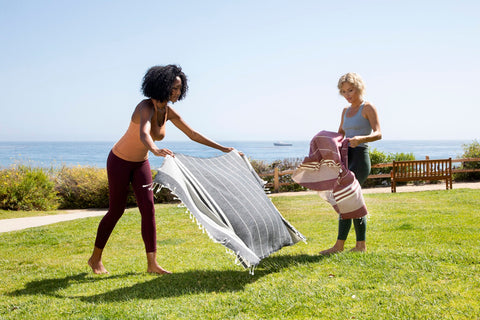
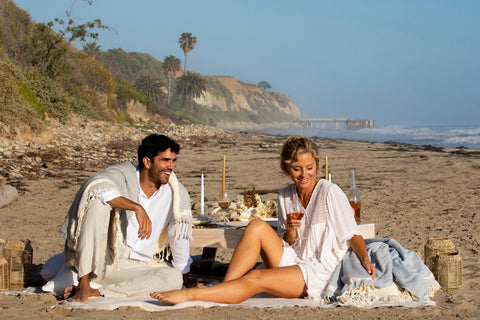
Over time the peshtemal travelled well beyond the bathhouse. It became a beach wrap, a throw over the shoulders, a picnic blanket and a table runner. That versatility is a big part of why flat-woven towels fit so naturally into promotional programmes today: one product can serve a spa, a pool deck and a living room.
Why does the cotton matter so much?
The Aegean region of Turkey is well known for cotton, and we use long-staple cotton from there. Staple length simply refers to the length of the individual fibres. Longer fibres can be spun into smoother, stronger yarn, with fewer loose ends, and that translates into cloth that feels soft against the skin, resists pilling and holds up to repeated washing.
It is a bit like the difference between a long, silky strand of hair and a short, frizzy one. You may not name it when you touch a towel, but you feel it. We explain the material in more depth in Turkish Cotton Explained.

What are the mills actually like?
For our flat-woven Turkish towels we work with small family-run mills. Anyone who has visited a workshop like that knows the atmosphere: the steady rhythm of looms, a supervisor who can hear when something is off, and the sense that the person who owns the business is also the person who checks the cloth. Quality is personal there, because the family name is on the work.
Turkey is also home to major textile centres, with Denizli among the best known, and a supply chain that has grown up around them: spinners, dyers, finishers and loom specialists within reach of one another. That ecosystem is hard to replicate elsewhere. It shortens the distance between an idea and a finished sample, and it lets craftspeople solve problems face to face.
A small mill knows every towel it ships, because the family behind it can be found on the floor.
Is it all handwork, or do the mills use modern machines?
Both, and that blend is the point. Flat-woven towels come out of mills with a traditional character, while our knit and jacquard blankets use circular knitting machines and computerized jacquard looms. Computerized jacquard is what allows a client's logo to be built into the structure of a blanket with precision, and circular knitting is what gives knit blankets their body and softness.
Using each tool for what it does best means a towel can feel timeless while a blanket can carry a sharp, detailed design. If you are curious about the manufacturing journey, From Loom to Logo walks through it.

What does making in Turkey change for the finished product?
Four things stand out.
- Feel. Long-staple cotton and a flat weave give a smooth, light, pliable cloth that softens with every wash.
- Look. Traditional structures, fringe and stripes give a Mediterranean sensibility that feels stylish rather than generic.
- Customisation. Mills used to developing designs can handle logos woven in, stitched on or printed, as well as custom colours matched to a Pantone equivalent.
- Character. Small-scale production means each piece is handled by people who care about it, and it shows.
Your end clients increasingly ask where things come from. A towel with a real heritage, a named region of origin and a visible link to craft gives you a better answer than a vague one. You can speak with confidence about the cotton, the mills and the methods, which makes your proposal more memorable.
How do you get from a Turkish mill to a California warehouse?
We run a two-sided model. Some inventory is ready to ship from California, which suits tight deadlines. Additional inventory in Turkey ships in 7 to 10 days, and made-to-order production takes about two weeks in Turkey. The mills are the heart of that rhythm, and our team coordinates between your project and theirs.
Before anything reaches you, each piece is inspected, pressed, folded and packed. It is a small step, but it is the one that turns production into product, and we do not skip it. To see what is available to ship, check our inventory page.

How does this connect to our ocean mission?
Towels, blankets, robes and beach bags live near the water. They go to beaches, pools, resorts and coastlines. That is why our mission is helping heal and protect the oceans: the products belong to that world, so it makes sense for the business to give something back to it. A long-lasting natural-fibre towel that someone keeps for years is, at the very least, a more thoughtful object than something designed to be thrown away. We tell that story in Custom Turkish Towels That Give Back.
Is Turkey the right choice for every project?
Honesty is part of being a good partner, so here is a fair answer: Turkey is the right choice when you want craft, material quality and design flexibility. If a project is purely about the lowest possible unit cost on a generic product, a different sourcing route might fit better. Where our approach shines is the middle and upper end of promotional textiles, where the recipient will actually touch, use and keep the product.
It also suits distributors who like to be involved. Because we work in direct relationship with the mills, you can ask real questions, request virtuals and samples and get real answers. If you want to discuss a project, our contact form is the quickest route.
What should you ask any supplier about where their textiles are made?
Whether you buy from us or someone else, a few questions separate real provenance from a vague claim. They are worth keeping on a card next to your desk.
- Which region does the cotton come from, and what kind of cotton is it?
- Who actually weaves the cloth, and how big is the operation?
- Can I see samples of the actual product, not just a catalogue photo?
- How is colour matched, and to what standard?
- What happens to each piece between the loom and the box?
We are comfortable with every one of those questions, which is rather the point of working with mills we know. Clear answers are a sign of a supply chain with nothing to hide, and they give you material to reassure your own clients.
What are the people behind it like?
Textiles can feel anonymous when they arrive folded in a box, but each one has passed through many hands: the farmers who grew the cotton, the spinners, the weavers, the finishers and the people who press and pack. What strikes visitors to Turkish mills is how proud everyone is of the work. That pride is not something you can specify on a purchase order, but it is the reason we keep returning to the same kind of partner.
Frequently asked questions
Why are Turkish towels considered high quality?
Turkey has a long weaving tradition and grows cotton along its Aegean coast. Long-staple cotton makes a smoother, stronger yarn, and skilled mills turn it into flat-woven cloth that is light, absorbent and quick to dry.
What kind of mills do you work with?
For flat-woven Turkish towels we work with small family-run mills. For knit and jacquard blankets we work with makers that use circular knitting machines and computerized jacquard looms.
Where does your cotton come from?
We use long-staple cotton from the Aegean region of Turkey, which is known for producing fibre that spins into a smooth and durable yarn.
Do you keep any stock in the United States?
Yes. Some inventory is ready to ship from California, and additional inventory in Turkey ships in 7 to 10 days. Made-to-order production takes about two weeks in Turkey.
Bring a little Aegean craft to your next project
See what is ready to ship, or tell us about a custom idea and we will take it from there.
View inventory Start a conversation